
Get Paid on Time: A Beginner Freelancer Guide
A practical beginner guide to getting paid on time as a freelancer: deposits, milestones, invoices, due dates, and scripts to stop late payments.
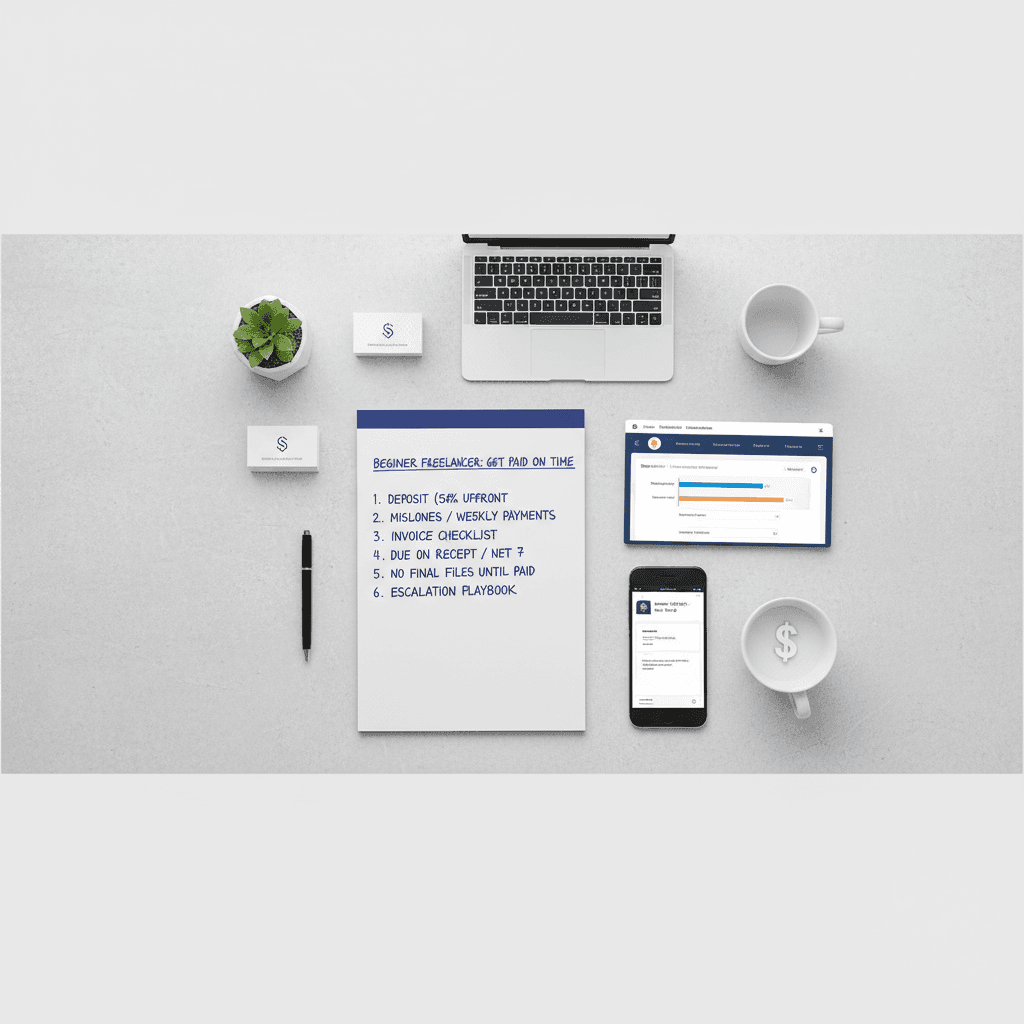
Introduction
If you’re new to freelancing, “getting the client to say yes” feels like the finish line.
It isn’t. Getting paid on time is the real finish line. And it’s where most beginners get burned—because they rely on goodwill, vague scopes, and “I’ll send an invoice after.”
Late payments don’t just hurt your cash flow. They quietly force you to take worse clients, accept rush work, and discount your rates to survive.
This guide gives you a simple system—terms, structure, and scripts—so you can get paid on time without becoming aggressive or spending your life chasing invoices.
Why Freelancers Don’t Get Paid on Time
Getting paid late is rarely about “bad people.” It’s usually about bad systems.
Here are the most common reasons beginners get stuck:
- No deposit. You start work with nothing committed, so the client feels zero urgency.
- Vague scope. The client thinks they’re buying “results,” you think you’re selling “time.” That mismatch causes delays and disputes.
- No clear due date. “Net 30” is fine if you can float a month. Most beginners can’t.
- Invoicing is an afterthought. You send an invoice days later, to the wrong person, without a PO, and it falls into the void.
- You hand over the final deliverable before payment. That’s the classic mistake. Once they have the value, you’ve lost leverage.
- No escalation plan. You feel awkward following up, so you wait. Waiting is expensive.
Why this matters for freelancers: paid-on-time clients are not “luck.” They’re the result of expectations set early—and enforced through structure.
The goal is to design the project so late payment becomes inconvenient for the client, not for you.
Set Payment Terms Before You Talk About Deliverables
Most beginners do this backwards: they discuss the work, agree on scope, then “figure out payment.”
Do the opposite. Set terms while the deal is still being shaped. That’s when you have the most leverage and the least awkwardness.
The four terms you need (minimum)
-
Deposit amount
- Common: 50% upfront for projects under $10k
- Alternative: first milestone upfront (if the project is milestone-based)
-
Invoice schedule
- Example: “50% upfront, 50% before final files are delivered.”
- Or: “Paid weekly on Mondays for ongoing work.”
-
Payment due date
- For beginners: Due on receipt or Net 7
- If a client demands Net 30, treat it like a negotiation (more below)
-
Payment methods
- Card + bank transfer is standard
- If they only pay by check, add time buffers and get mailing details early
A simple payment terms line you can copy
Use this in your email recap or agreement:
Payment terms: 50% deposit to schedule the project, remaining 50% due before final delivery. Invoices are due on receipt. Work pauses on overdue invoices.
That last sentence is doing a lot of work. It’s not aggressive—it’s operational.
What to say when a client asks for Net 30
If you’re just starting out, Net 30 can wreck your cash flow. You can still accommodate it, but trade it for something.
Script:
“I can do Net 30 for established vendors. For new engagements, I usually do 50% upfront to reserve capacity. If Net 30 is required, I’d need either a smaller initial scope or weekly billing so cash flow stays predictable.”
Options you can offer:
- Weekly billing on ongoing work
- Smaller first project (“paid pilot”)
- Higher price to finance the delay (yes, this is normal)
Why this matters for freelancers: when you set terms early, you filter out clients who can’t pay and reduce the emotional load of chasing money later.
Use a Payment Structure That Prevents Nonpayment
The best way to get paid on time is to make it impossible to keep working without payment.
Not by threatening. By designing the project so payment gates are built-in.
Choose the right structure for the type of work
1) Fixed project (best for clear deliverables)
Use deposits + delivery gates.
Recommended structure:
- 50% upfront
- 40% due at “ready for final delivery”
- 10% due after launch support (optional, if you want a small post-launch buffer)
If you’re a beginner, keep it simpler:
- 50% upfront / 50% before final delivery
2) Milestone-based (best for bigger builds)
Each milestone has:
- deliverables
- acceptance criteria
- invoice due before next milestone starts
Example for a website:
- Milestone 1: sitemap + wireframes (paid)
- Milestone 2: design comps (paid)
- Milestone 3: build + QA (paid)
- Milestone 4: launch support (paid)
3) Retainer / ongoing (best for recurring work) For retainers, the most important rule is: bill upfront.
Example:
- “$2,000/month billed on the 1st”
- “Work begins when payment clears”
- “Unused hours don’t roll over” (or define rollover explicitly)
The “no final files until paid” rule
This feels scary at first, but it’s standard.
Make it explicit:
“Final deliverables are released after the final invoice is paid.”
If you’re worried about trust, offer a preview:
- watermarked designs
- staging links
- recorded walkthrough
- screen share
Why this matters for freelancers: beginners often lose leverage at the exact moment they need it most—right before final delivery. Payment gates protect you from the “we’ll pay next week” trap.
Make Invoicing Frictionless (and Hard to Ignore)
Late payments often come from admin friction, not malice.
Your job is to make paying you easy, fast, and obvious.
Invoice checklist (beginner-proof)
Every invoice should include:
- Your business name + contact
- Client legal name (not just “Sarah”)
- Invoice number (INV-001, INV-002…)
- Date issued
- Due date (bold it)
- Line items with clear labels (avoid “work”)
- Total due
- Payment link / bank details
- Late fee policy (if you use one)
- Where to send remittance details (optional)
Send invoices to the right person (this is huge)
Ask on the call:
“Who handles payment on your side, and what do they need from me—PO number, vendor form, W-9?”
If the client says “Accounting,” don’t wait. Get:
- AP email address
- required fields (PO, project code)
- payment run schedule (some companies only pay twice a month)
Set a tight due date and remind proactively
For beginners, I recommend:
- Due on receipt for deposits
- Net 7 for milestones and finals
Then use reminders:
- 3 days before due date
- On due date
- 3 days after due date
Keep the reminders short and purely operational.
Template:
Subject: Invoice INV-014 due on April 17
Hi [Name] — quick reminder that INV-014 for $1,500 is due on April 17.
Here’s the payment link: [link]
Thanks,
[You]
Consider late fees (but don’t lead with them)
Late fees can work, but only if the client is sophisticated enough to take them seriously.
A reasonable policy:
- 1.5% per month after 7 days overdue
Or: - $50/week after 7 days overdue
The real power is not the fee—it’s the work pause clause.
Why this matters for freelancers: a clean invoice plus the right contact prevents “we didn’t see it” and “we can’t process it” delays—the two most common beginner pain points.
Handle Late Payments with a Calm Escalation Playbook
You don’t need to be intense. You need to be consistent.
Here’s an escalation ladder that protects the relationship while protecting your cash flow.
Day 1 overdue: assume it’s an oversight
Subject: Overdue invoice INV-014
Hi [Name] — looks like INV-014 is now past due. Can you confirm when it’s scheduled to be paid?
Payment link: [link]
Day 3 overdue: introduce a work pause (politely)
Thanks—since the invoice is overdue, I’m going to pause work until it’s resolved. As soon as payment is in, I’ll resume and update the timeline.
You’re not punishing them. You’re managing your schedule.
Day 7 overdue: widen the circle
If you’ve been emailing one person, add the payer.
Hi [Name] — looping in [AP/Finance Contact] so we can get this closed out. INV-014 is 7 days overdue.
Please confirm the payment date and any info you need from me (PO, vendor form, etc.).
Day 14+ overdue: formal notice + next steps
At this point, stop writing emotional emails. Be procedural.
This is a formal notice that INV-014 remains unpaid. Work is paused.
If payment isn’t received by [date], I’ll proceed with [collections/small claims/late fee per agreement].
(Only mention actions you’re willing to take.)
What not to do
- Don’t keep delivering “to show goodwill.”
- Don’t accept vague promises (“next week”) without a date.
- Don’t argue about the value of your work in an invoice thread.
If they dispute the work, move it to a call. But keep payment gates intact.
Why this matters for freelancers: late payments aren’t just lost money—they’re lost time and emotional energy. A playbook prevents you from improvising under stress.
Close the Loop on the Call So You Don’t Chase After
If you want to get paid on time, your best tool isn’t an invoice.
It’s what happens on the call where the client says yes.
Most freelancers end that call with:
- “I’ll send a proposal”
- “I’ll email the next steps”
- “Let me know”
That creates the proposal gap: time passes, excitement fades, stakeholders multiply, and you get ghosted or delayed.
A better approach: turn the call into a live closing session where scope, pricing, and payment are agreed in real time.
The “close-ready” call agenda (20–30 minutes)
- Confirm the goal and deadline
- Define deliverables (plain language)
- Confirm what “done” means
- Present price + options
- Confirm payment terms
- Start immediately with deposit
Scripts that lock in payment without being pushy
When they say yes:
“Perfect. To reserve the start date, I’ll send the invoice for the deposit now. If you can take care of it today, I’ll get kickoff scheduled.”
When they want to think about it:
“Totally fair. What specifically do you need to decide—budget, internal approval, or comparing options? If we can answer that now, we can save a week of back-and-forth.”
When they ask for a proposal anyway:
“I can send a summary, but I’ve found proposals slow everything down. If we’re aligned, let’s confirm scope and terms now and get the deposit in—then I’ll send the recap for your records.”
Where Manager List fits (and why it matters)
If you’re constantly losing momentum after discovery calls, the fix is not “write better proposals.” It’s close live.
Manager List is built for that moment:
- present services and options live
- adjust pricing in real time
- capture signature before you hang up
No PDFs. No follow-up emails. No ghosting.
Why this matters for freelancers: getting paid on time starts with getting the commitment on time. If the agreement and deposit happen during the call, you’re not chasing—you're scheduling.
Conclusion
Getting paid on time isn’t about being strict. It’s about being clear.
Start with simple payment terms, use a deposit + delivery gates, send clean invoices to the right person, and follow a calm escalation plan when payments slip.
Your practical next step: on your next discovery call, don’t end with “I’ll send a proposal.” End with terms, timeline, and the deposit invoice sent while you’re still on the call.
Frequently Asked Questions
- Should a beginner freelancer really charge a deposit?
- Yes. A deposit filters out non-serious clients and protects your schedule. For most beginner-friendly projects, 50% upfront is a clean standard. If a client refuses any deposit, shrink the scope into a paid pilot or walk away.
- What payment terms are best when you're just starting out?
- Use “due on receipt” for deposits and Net 7 for the remaining balance or milestones. Net 30 is common for larger companies, but it’s a cash-flow cost—trade it for weekly billing, a smaller scope, or a higher price.
- Is it okay to pause work for late payment?
- It’s not only okay—it’s necessary. Put it in writing upfront: work pauses on overdue invoices. Then enforce it calmly and consistently so you don’t end up financing the project with your time.