
How to Subcontract Work Without Losing the Client
A practical guide to subcontracting as a freelancer: contracts, client communication, pricing, QA, and handoffs so you deliver faster without risk.
Introduction
Subcontracting is one of the fastest ways to increase your capacity without raising your hours. It’s also one of the fastest ways to lose a client if you do it sloppily.
The tricky part isn’t finding help. It’s keeping trust while you delegate work the client assumed you would personally do.
This guide shows you how to subcontract (or outsource) without surprises, without quality dips, and without payment risk—including exact language you can use and a simple process to keep delivery tight.
Decide If Subcontracting Is Allowed (and Smart)
Subcontracting isn’t just an operational decision. It’s a promise-management decision. Your client bought a result, but they also bought confidence—and sometimes you.
Here’s how to decide quickly.
Check these 3 “permission” constraints
-
Contract constraints
If your client contract says you can’t assign or subcontract, you need written consent. Don’t assume you can “just do it quietly.” -
Security/Confidentiality constraints
If you’ll expose customer data, production credentials, unpublished IP, or regulated info (HIPAA/PCI/GDPR), subcontracting may require:
- a stronger NDA
- least-privilege access
- client approval of vendors
- proof of compliance
- Brand/voice constraints
If the output must match a very specific voice (copywriting) or a very specific craft standard (design), subcontracting can work—but only if you own the final pass.
Use this simple “should I outsource this?” filter
Outsource when the task is:
- repeatable (same pattern each time)
- spec-defined (clear acceptance criteria)
- reviewable (you can verify quality quickly)
Keep in-house when the task is:
- strategic (requires judgment with client context)
- high-trust (client expects your personal involvement)
- hard to verify (quality is subjective and slow to evaluate)
Why this matters for freelancers: the client doesn’t care that you’re scaling. They care that delivery stays predictable. This filter prevents you from outsourcing the parts that create trust.
Set the Rules in Writing Before You Hire Anyone
Most subcontracting failures aren’t talent problems. They’re ambiguity problems.
You need two layers of protection:
- your client agreement (what the client can expect)
- your subcontractor agreement (what you can enforce)
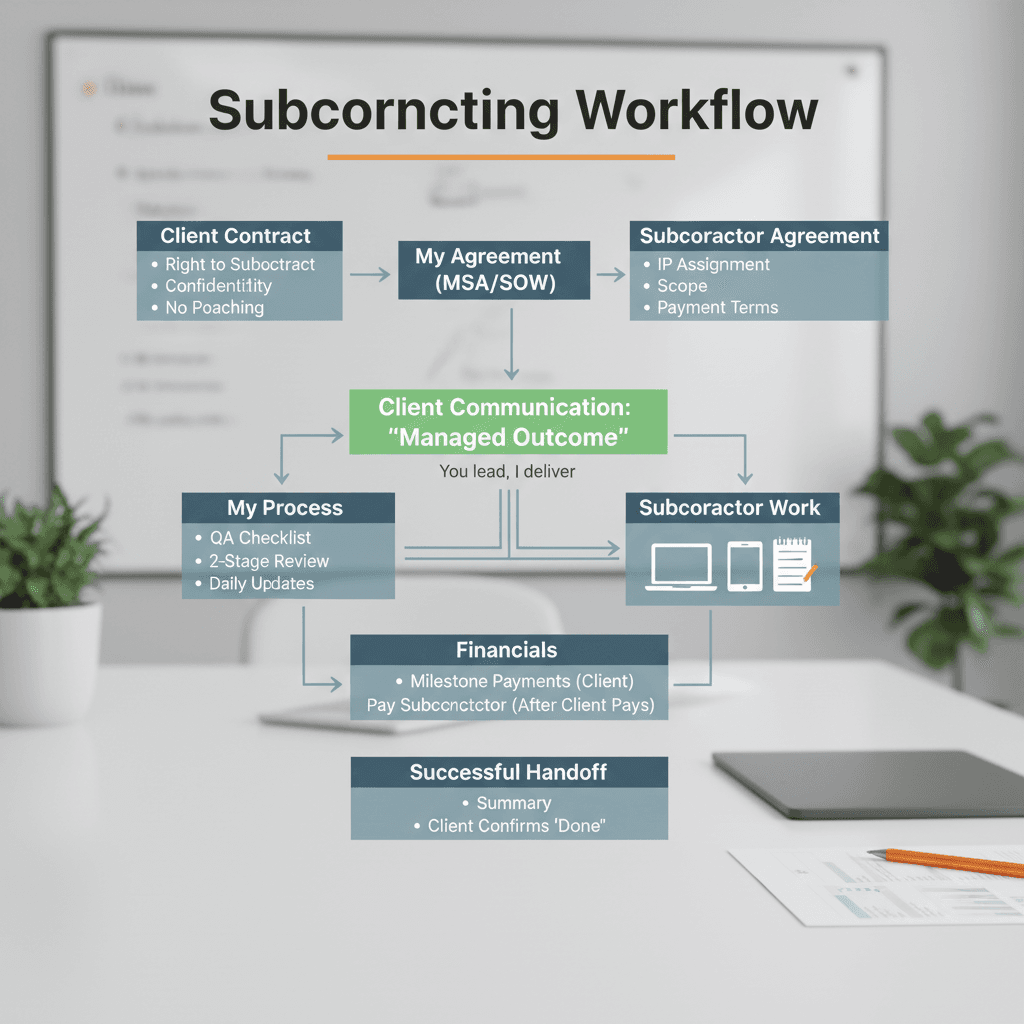
Add (or verify) these 6 clauses in your client agreement
If you already have a Master Services Agreement (MSA) + Scope of Work (SOW), great. If not, don’t overcomplicate it—just make sure these show up somewhere:
-
Right to subcontract
Plain language: “Contractor may engage subcontractors to perform services, provided Contractor remains responsible for all deliverables.” -
Responsibility stays with you
Client shouldn’t have to chase vendors. Ever. -
Confidentiality + data handling
Confirm you’ll flow down NDAs and keep access controlled. -
No direct-client poaching
Optional but useful: “Client agrees not to solicit or contract directly with Contractor’s subcontractors during the project and for X months after.” -
Acceptance criteria and revision limits
Subcontracting amplifies revision chaos. You need boundaries. -
Payment timing
If you have to pay others, you can’t float invoices for 30–60 days without cash stress.
Use a tight subcontractor agreement (non-negotiables)
At minimum, include:
- Work product assignment: all IP created is assigned to you (so you can assign to client)
- Confidentiality + non-disclosure
- Non-solicitation (they won’t approach your client)
- Scope + deliverables + deadlines
- Payment terms (and what happens if client pauses)
- QA expectations (format, file naming, docs, testing)
- Termination + handoff obligations
If you don’t want to pay a lawyer yet, keep it simple—but get signatures. A “sure, sounds good” in Slack is not protection.
Why this matters for freelancers: subcontracting increases your risk surface area. Written rules keep one mistake from turning into a client dispute, a refund, or an IP mess.
Talk to the Client Without Making It Weird
Freelancers often avoid mentioning subcontractors because they fear the client will say: “Then why am I paying you?”
That’s a real risk—if you frame it wrong.
The client isn’t paying for your keystrokes. They’re paying for accountability, process, and a consistent outcome.
Decide your disclosure level
There are three common approaches:
-
Transparent (named subcontractor)
Best when the subcontractor will attend meetings, access systems, or be visible in deliverables.
Example: “I’m bringing in a specialist designer to speed up UI production.” -
Transparent (unnamed support)
Best when you want the benefit without introducing a new relationship.
Example: “I have additional production support to hit the timeline.” -
No disclosure (only if your contract allows it and risk is low)
Use carefully. If the client later discovers it (they usually do), you’ll be judged on whether it improved delivery or introduced risk.
If you’re unsure, choose option 2. It’s honest without turning your team structure into a debate.
Scripts you can use (steal these)
When you want to position it as a benefit (speed + quality):
“I’ll be leading the work end-to-end. For production, I may use vetted support so we can move faster without compromising quality. I’m still your single point of contact.”
When the client is sensitive about “who touches the work”:
“All deliverables still go through my QA and final pass. You’re not managing anyone else, and nothing ships without my review.”
When the client asks ‘why not just hire them directly?’
“You could, but what you’re buying from me is a managed outcome: scope control, quality control, and on-time delivery. If anything slips, it’s on me—not you.”
What to avoid saying
- “I’m too busy so I’m outsourcing this.” (signals lack of capacity)
- “It’s cheaper if I hire someone overseas.” (turns it into a cost/ethics conversation)
- “They’re basically doing most of it.” (reduces your perceived value)
Why this matters for freelancers: your rate is justified by certainty. This language keeps you positioned as the owner of the result, not a middleman.
Price and Payments So You Don’t Fund the Project
Subcontracting changes your cash flow. If you don’t adjust payment structure, you’ll end up fronting payroll while waiting on client invoices.
That’s how freelancers get trapped.
Keep your pricing model, but tighten the terms
You have two viable approaches:
Option A: Fixed project price (with milestone payments)
Best when scope is clear.
- 40–50% upfront
- 25–30% at midpoint
- remainder on delivery (before final files or launch)
If a client pushes Net-30/Net-45, your counter is simple: “I can do Net-30 on ongoing retainers. For project work with production scheduling, I require milestone payments to reserve capacity.”
Option B: Retainer with defined deliverables
Best when scope might evolve.
- monthly upfront payment
- clear “what’s included” list
- overages billed weekly or at a capped rate
Never pay subcontractors “hoping” you’ll get paid
Match outgoing costs to incoming cash.
A practical rule: your client’s first payment should cover at least 100% of your initial subcontractor commitment.
Example:
- You need to pay a contractor $1,500 to start.
- Your client deposit must be at least $1,500 (preferably more).
Build margin like an operator, not a hopeful freelancer
If you subcontract $2,000 worth of work, your price should not just be $2,000 + a tiny markup.
Your margin covers:
- management time
- QA and revisions
- risk and rework
- context switching
- client communication
A typical range: 25–60% gross margin depending on how much you’re managing and how risky the work is.
Use a “change order” trigger
Subcontracting makes scope creep expensive. Add a simple rule:
- Any request that changes deliverables, timeline, or assumptions triggers a written change order.
If you use Manager List on calls, this is where it shines: you can adjust line items live, confirm the new price, and capture approval before the call ends—no “I’ll think about it” limbo.
Why this matters for freelancers: subcontracting is a leverage play. Bad payment terms turn it into debt and stress.
Quality Control and Delivery When Someone Else Does the Work
Your client will judge you on quality. Not your subcontractor. That means you need a system that makes quality predictable.
Use “definition of done” like a checklist
For each deliverable, write acceptance criteria that are easy to verify.
Examples:
Design deliverable: landing page UI
- Figma file organized with named frames
- components use a consistent style system
- mobile + desktop included
- assets exported in SVG/PNG as specified
- accessibility: color contrast meets WCAG AA
- copy placeholders clearly labeled
Development deliverable: marketing site section
- passes Lighthouse performance threshold (e.g., 85+)
- responsive across breakpoints
- no console errors
- includes basic unit tests or QA steps
- deployed to staging URL
Now your subcontractor knows what “done” means—and you can review faster.
Implement a two-stage review (cheap + effective)
-
Internal review (you)
You check for structure, completeness, obvious defects. -
Client-facing review
Only after you’ve cleaned it up and aligned it to the brief.
Never show “first draft from the subcontractor” to the client. That’s how you leak process mess.
Protect the timeline with daily async updates
You don’t need meetings. You need visibility.
Have subcontractors send a daily note:
- what I shipped today
- what’s blocked
- what I’m doing tomorrow
- links to work
It prevents last-minute surprises and makes it obvious when someone is drifting.
Control access like you’re a small agency
- Use separate accounts where possible
- Give least-privilege access (read-only unless needed)
- Avoid sharing root credentials
- Use expiring invites and remove access at the end
Why this matters for freelancers: subcontracting only works if you can consistently deliver a “professional finish.” QA and access control are the difference between scaling and scrambling.
Close the Loop Cleanly (So the Client Feels More Supported, Not Less)
Your goal is for the client to feel like subcontracting made the experience better: faster responses, smoother delivery, and clearer next steps.
Run a tight handoff process
Before final delivery, prepare:
- a short “what changed + where to find it” summary
- next-step recommendations (optional, but valuable)
- a “known limitations” note (so nothing is surprising later)
- credentials/access handover plan (who owns what)
If subcontractors joined calls, reset roles clearly
Clients get confused when they meet “the team.” They wonder who’s accountable.
Say it directly: “I’m still accountable for delivery and timeline. [Name] supports production on X. Any requests or changes still come through me so we stay coordinated.”
Close the project with a final agreement on what’s “done”
This is where freelancers often lose days of unpaid tweaks.
Use a closing statement: “If you confirm these deliverables meet the acceptance criteria, I’ll consider the project complete and archive the workspace. Any new requests can be handled as a new scope.”
If you’re using Manager List, this is also a perfect moment to:
- present the next phase
- adjust pricing live (based on what they just learned they need)
- capture signature immediately—before momentum dies
Why this matters for freelancers: the real risk isn’t doing the work—it’s getting stuck in endless “small changes” after the subcontractor is gone and your margin is gone with them.
Conclusion
Subcontracting is a growth lever, but only if you treat it like a system: permission, paperwork, positioning, payments, and QA.
Your next step: pick one upcoming project and implement the minimum viable version of this:
- add the right-to-subcontract clause
- use milestone payments that cover subcontractor costs
- write a definition of done
- run a two-stage review before the client sees anything
If you want to turn your discovery call into an actual closing session, use a live scope-and-price flow (like Manager List) so you can align on deliverables, update pricing in real time, and collect approval before the call ends—no PDFs, no follow-ups, no ghosting.
Frequently Asked Questions
- Do I have to tell clients I’m using subcontractors?
- Not always, but you should assume it may come up. If your contract allows subcontracting and the subcontractor won’t be visible or handle sensitive access, you can keep it framed as “production support.” If they’ll touch systems/data or join calls, disclose it and reinforce that you remain accountable for quality and delivery.
- How do I stop a subcontractor from stealing my client?
- Use a signed subcontractor agreement with confidentiality and non-solicitation language, limit direct access to the client, and keep all requests flowing through you. Also avoid introducing subcontractors to the client unless there’s a clear reason.
- What should I do if my subcontractor misses a deadline?
- Treat it like a delivery risk you own: communicate early to the client with a revised timeline, reduce scope if needed, and reassign or take over the task. Internally, tighten acceptance criteria, require daily async updates, and don’t keep a subcontractor who repeatedly surprises you.
- How much margin should I add when subcontracting?
- Enough to cover management, QA, revisions, and risk. A practical range is 25–60% gross margin depending on complexity. If you’re deeply managing (multiple handoffs, subjective quality, tight deadlines), you need more margin—not less.