
Productized Service Checklist for Freelancers
Use this productized service checklist to scope, price, sell, and deliver faster without custom proposals or messy client handoffs.
Introduction
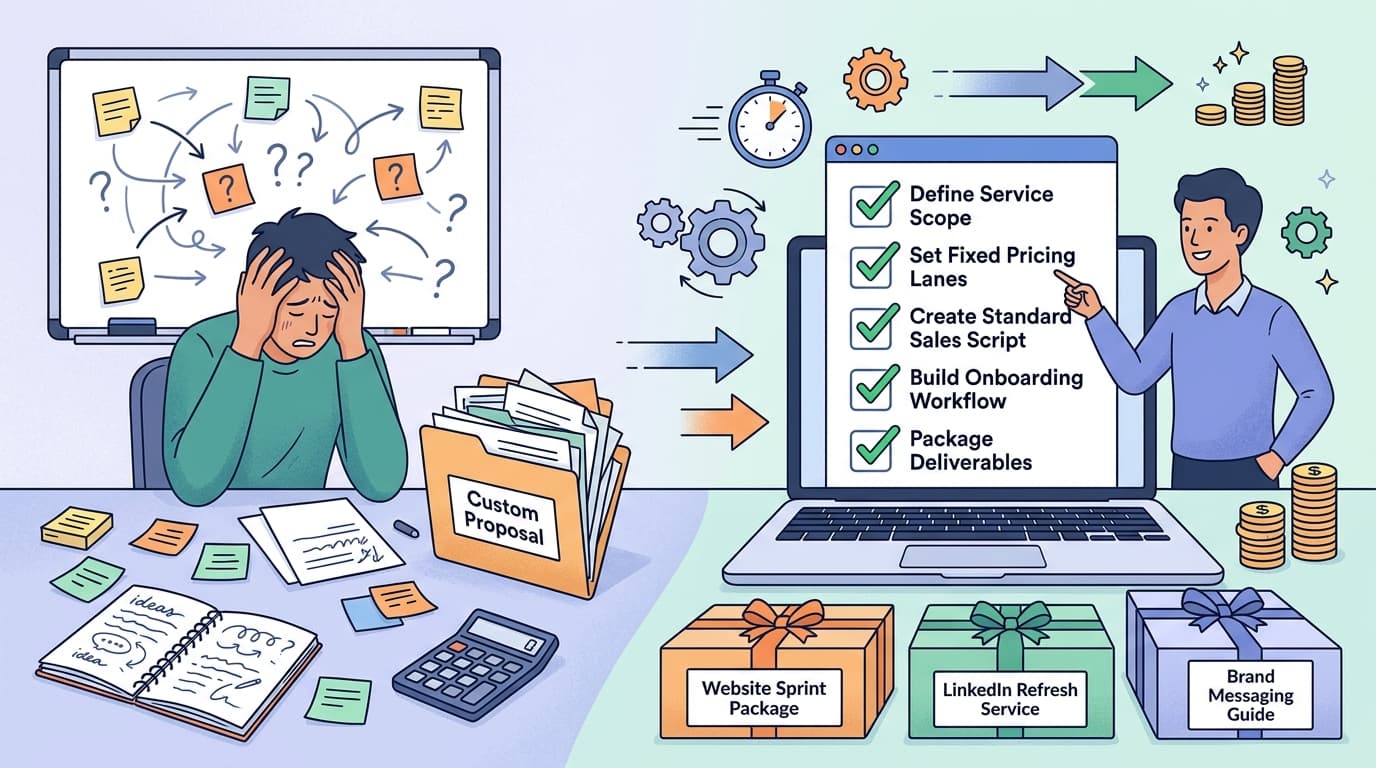
A lot of freelancers say they want productized services, but what they actually have is a slightly cleaner custom offer.
That sounds fine until sales calls drag on, every client asks for something different, pricing gets negotiated into the floor, and delivery becomes a pile of exceptions. The real value of a productized service is not just better packaging. It is faster selling, clearer expectations, and easier delivery.
This checklist walks you through a specific freelancer process: turning a service into a productized offer you can sell repeatedly. If you want fewer proposal loops, tighter scope, and a smoother path from discovery call to signed client, this is the process that matters.
Choose One Service Worth Productizing
The biggest mistake freelancers make is trying to productize everything at once.
Start with one service you already deliver well. Ideally, it should solve a clear problem, follow a repeatable process, and produce a defined outcome. If every project needs a brand-new method, it is too early to package it.
Checklist: Validate the right service
- Pick a service you have delivered at least 3–5 times
- Confirm the client problem is easy to explain in one sentence
- Confirm the process is mostly repeatable
- Confirm the result can be described clearly
- Confirm you can estimate time and effort with reasonable accuracy
- Remove services that rely heavily on endless revisions or unclear strategy
Here is a weak productized offer:
- "I help businesses with marketing."
Here is a stronger one:
- "I create a 5-page website in 10 business days for service businesses."
That second version works because it defines what the client gets, who it is for, and how long it takes.
Why this matters for freelancers
If you choose the wrong service, every sale becomes custom again. That means more back-and-forth, more pricing confusion, and more delivery stress. A productized service only works when the offer is narrow enough to be repeatable but valuable enough to justify a strong price.
A good test: if you still need a long proposal to explain what is included, your offer is probably not productized yet.
Define the Offer Like a Product, Not a Custom Project
Once you choose the service, define it the way a software company would define a product.
That means setting clear boundaries. What is included. What is not included. What the client needs to provide. What success looks like. If those details are vague, clients will fill in the blanks with their own assumptions.
Checklist: Build the offer definition
- Write a one-line promise for the offer
- Define the ideal client
- List exact deliverables
- Set a delivery timeline
- State client responsibilities
- State revision limits
- State what is explicitly excluded
- Define upgrade paths if clients want more
A practical example:
Offer: LinkedIn Profile Refresh for B2B founders
Includes:
- Profile headline rewrite
- About section rewrite
- Experience section optimization
- Custom call-to-action
- One round of revisions
- Delivery in 5 business days
Excludes:
- Full personal brand strategy
- Content calendar
- Ghostwritten posts
- Team training
Upsells:
- Add 5 ghostwritten posts
- Add profile banner design
- Add founder messaging session
This is where many freelancers lose the plot. They want flexibility because it feels client-friendly. In practice, too much flexibility creates friction. Clients do not buy faster when the offer is fuzzy. They buy faster when it is easy to understand and easy to compare.
Why this matters for freelancers
A defined offer reduces scope creep before the project even starts. It also makes sales calls shorter because you are not inventing the engagement live. Instead, you are matching a client to a structured service and adjusting only where needed.
That is the difference between selling a package and building a proposal from scratch.
Set Pricing, Scope, and Guardrails Before You Sell
If your pricing falls apart the moment a client asks one question, your offer is not ready.
Productized services need pricing logic that is simple enough to explain on a call but strong enough to protect your margin. You do not need one fixed price for every possible client, but you do need predefined pricing lanes.
Checklist: Price the offer properly
- Set a base price for the standard package
- Decide what triggers a higher price
- Create 1–3 add-ons
- Set a rush fee if needed
- Decide your payment terms
- Write down your refund or cancellation policy
- Define what happens if the client delays feedback
- Create a script for pricing objections
A simple structure might look like this:
Standard package: $1,500
Rush delivery: +$300
Extra revision round: +$150
Additional page or asset: +$250
Strategy call add-on: +$200
This works because the client can see the base offer and the cost of expanding scope. You are not guessing. You are not apologizing. You are giving them a menu with boundaries.
Create scope guardrails now, not later
Use direct language:
- One round of revisions included
- Feedback due within 3 business days
- Delays longer than 7 days pause the project
- Additional deliverables are billed separately
- Calls beyond the included session are charged at a fixed rate
Freelancers often avoid these terms because they worry they sound rigid. The opposite is true. Clear guardrails make you look organized and experienced.
Why this matters for freelancers
This is where profitability is won or lost.
Without guardrails, productized pricing becomes fake. You charge a fixed fee, then quietly absorb extra work until the project becomes a bad deal. That hurts your time, your confidence, and your ability to scale the offer.
Good pricing protects both the sale and the delivery.
Build a Sales Process That Closes on the Call
A productized service should not require a long sales cycle.
If the offer is clear, your call should focus on fit, urgency, objections, and next steps. Not on writing a custom proposal after the meeting. The more often you end a promising call with, "I’ll send something over," the more often the deal slows down or disappears.
Checklist: Prepare a close-ready sales flow
- Start with the client’s problem and desired outcome
- Confirm they fit your defined offer
- Walk through the package live
- Adjust with predefined add-ons only
- State price clearly and confidently
- Confirm timeline and start date
- Handle objections live
- Ask for the decision on the call
- Be ready to collect signature and payment immediately
A simple call flow:
-
Clarify the problem
"What are you trying to fix in the next 30 days?" -
Qualify fit
"Based on that, my Website Sprint package is the best fit because you need speed and a clear scope." -
Present the package
"That includes 5 pages, copy implementation, one revision round, and delivery in 10 business days." -
Adjust within structure
"If you want booking funnel setup too, that is an add-on." -
Close directly
"If this works for you, we can lock the scope and get the agreement signed today."
This is one reason productized services convert well: they make the buying decision simpler.
Why this matters for freelancers
The longer the gap between call and close, the more likely the client goes cold, shops around, or rethinks the decision. A defined service gives you the confidence to present the offer live and move to signature without a week of follow-up.
For freelancers, that means less unpaid admin and faster cash flow.
Create a Delivery Workflow You Can Repeat Without Chaos
A productized service is not complete when the sales page is done. It is complete when delivery is repeatable.
You need a standard workflow that reduces decision fatigue and keeps clients moving. Every manual handoff, unclear request, and inconsistent milestone creates drag.
Checklist: Standardize delivery
- Create a kickoff form or intake questionnaire
- Create a standard client welcome message
- List all assets needed before work begins
- Build a delivery timeline with milestones
- Use templates for common client communications
- Define when and how revisions are collected
- Create a final delivery checklist
- Create a handoff or offboarding step
- Track common blockers to improve the offer
A simple workflow for a brand messaging package:
Before kickoff
- Signed agreement
- Invoice paid
- Intake form completed
- Existing brand materials submitted
During delivery
- Day 1: Review intake
- Day 2: Draft core messaging
- Day 4: Deliver draft
- Day 6: Collect revision feedback
- Day 8: Deliver final messaging pack
After delivery
- Send final files
- Offer add-on support
- Ask for testimonial
- Log lessons from the project
Make client responsibilities impossible to miss
Do not bury key steps in long emails. Put them into a checklist the client can follow.
For example:
To start on time, send these by Tuesday:
- Logo files
- Existing website copy
- Brand questionnaire
- Primary business goal
- Competitor examples
This is basic, but it matters. Many freelancers think delivery problems are caused by bad clients. Often, the real issue is unclear process design.
Why this matters for freelancers
A repeatable workflow helps you deliver faster without lowering quality. It also makes capacity easier to manage. When you know how long each package takes and where delays happen, you can book work more confidently and avoid overcommitting.
That is how a freelance service starts behaving like a real business asset.
Conclusion
A strong productized service is not just a renamed package. It is a clear offer, a clear price, a clear sales path, and a clear delivery system.
If you want fewer custom proposals and less sales friction, use this checklist in order. Pick one proven service. Define the scope tightly. Set pricing and guardrails. Sell it live. Deliver it through a repeatable workflow.
Your practical next step is simple: take the service you sell most often and write out the exact package in one page today. If you cannot explain what is included, what it costs, and how it gets delivered without opening a blank proposal doc, that is the bottleneck to fix first.
Frequently Asked Questions
- What makes a service truly productized?
- A productized service has a defined scope, fixed or structured pricing, a repeatable process, and a clear outcome. If every sale requires a custom proposal and custom workflow, it is not truly productized yet.
- Should productized services always have fixed pricing?
- Not always. Many freelancers use a base package with predefined add-ons, rush fees, or complexity tiers. The important part is that pricing logic is clear and can be explained quickly without building a quote from scratch.
- What if a client wants something outside the package?
- Treat it as an add-on, an upgrade, or a separate project. Do not quietly absorb extra work into the standard package. That is how productized offers lose profitability.
- Can high-ticket freelance services be productized?
- Yes, as long as the process and outcome are defined. High-ticket does not mean vague. It usually means the problem is more valuable, the expertise is stronger, or the service includes premium support within clear boundaries.