
The Hidden Cost of Keeping Late-Paying Clients
Late-paying clients cost more than cash flow. Learn the real tradeoffs, warning signs, and how freelancers can fix payment issues fast.
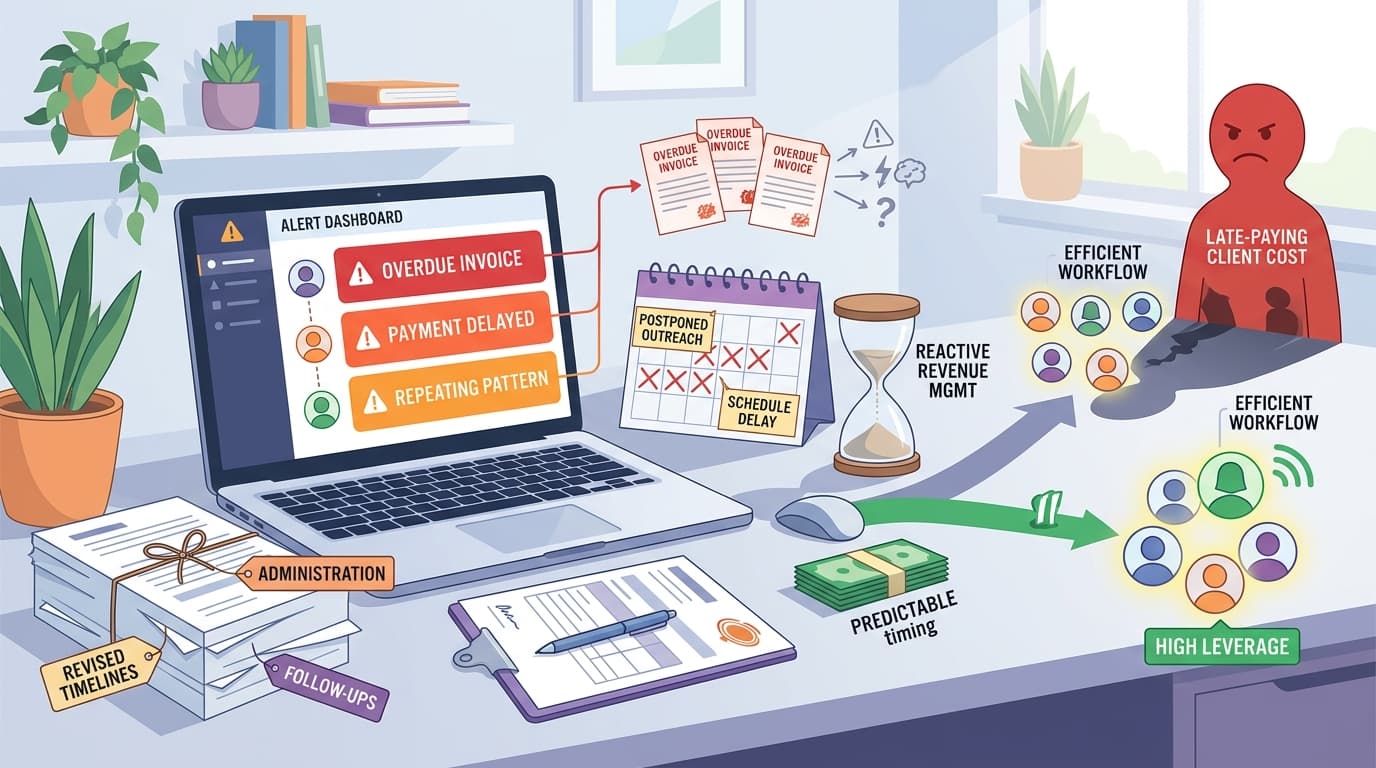
Introduction
Most freelancers think the cost of a late-paying client is obvious: you do the work, and the money shows up late.
That is only the visible part of the problem. The bigger cost is what that delay forces you to tolerate, postpone, and second-guess in the rest of your business.
A late-paying client changes how you price, how you sell, how you schedule, and how much stress you carry between projects. If you keep making exceptions for them, you are not just accepting slower payments. You are quietly redesigning your business around someone else’s bad behavior.
This guide breaks down the hidden tradeoffs of keeping late-paying clients, how to spot when patience becomes expensive, and what to do before one slow payer starts shaping your entire client process.
Why Late-Paying Clients Cost More Than the Invoice
The surface-level issue is simple: you are waiting for money you already earned.
But the real cost of late-paying clients is the chain reaction that follows. A delayed payment rarely stays isolated to one invoice. It spills into your planning, confidence, and capacity to take better work.
They create artificial cash flow pressure
If one client pays 30 days late, you may need to delay software renewals, contractor help, taxes, or your own salary draw.
That matters because freelancers do not just need revenue. They need predictable timing of revenue.
A client who pays $5,000 late can be more disruptive than a client who pays $3,000 on time. The second client is easier to run a business around.
They increase admin work you never priced in
Every late invoice creates follow-ups, reminders, status checks, revised timelines, awkward conversations, and extra bookkeeping.
That time is work. It may not be client-facing, but it still consumes attention.
For example, one “slow but good client” can trigger this sequence:
- Invoice sent on day 0
- Reminder sent on day 14
- Client asks accounting to review it on day 18
- You resend invoice on day 22
- Client says payment is coming next week on day 30
- You follow up again on day 37
- Payment arrives on day 45
You did not just wait 45 days. You also spent multiple touches managing avoidable friction.
They distort your sense of what is normal
This is where freelancers get stuck.
If you work with enough late-paying clients, you start building your business as if delayed payment is standard. You stop expecting deposits. You soften payment terms. You avoid firm conversations because you assume “this is just how clients are.”
It is not.
A client’s weak payment behavior should not become your operating model.
Why this matters for freelancers
Freelancers operate with less margin for error than larger firms. One delayed payment can affect rent, taxes, subcontractor costs, or your ability to say no to bad-fit work.
That means the hidden cost is not just inconvenience. It is the pressure to make worse decisions because cash arrived later than promised.
The Business Tradeoffs Freelancers Don’t Notice Fast Enough
The biggest danger with late-paying clients is not one overdue invoice. It is the silent tradeoff you make to keep the relationship alive.
You tell yourself you are being flexible. In reality, you are often subsidizing the client’s poor process with your own time, energy, and risk tolerance.
You keep working before getting paid
This is one of the most expensive habits freelancers develop.
A client misses an invoice, but you continue the next phase anyway because you do not want to stall momentum. Now you are no longer collecting on completed work. You are extending free credit while increasing your exposure.
A common example:
- Strategy phase completed
- Invoice is 18 days overdue
- Client wants to move into implementation
- You say yes to “keep things moving”
- Scope grows
- Outstanding balance grows
- Your leverage shrinks
The more work you complete before payment clears, the harder it becomes to enforce boundaries later.
You avoid stronger clients because you are covering gaps
Late payers create urgency, and urgency makes freelancers defensive.
Instead of spending time on outreach, referrals, or improving your close rate, you spend your week chasing money that should already be in your account. Then you tell yourself you are too busy to market.
You are not too busy. You are trapped in reactive revenue management.
You price around uncertainty
Many freelancers quietly raise prices to cover the emotional and financial cost of difficult clients.
That sounds reasonable, but it can create a worse outcome. You start charging more not because your value increased, but because your client process is weak. That makes sales harder and positioning less clear.
A better move is usually to fix payment terms, not pad your pricing to survive broken ones.
You train clients to expect exceptions
Every time you say:
- “No problem, just pay when you can”
- “We can start before the deposit”
- “I’ll send the contract later”
- “Let’s handle the invoice after the call”
You are teaching the client how your business works.
And clients learn fast.
If your process is loose during the first payment issue, they will expect looseness again when scope expands, revisions stack up, or final approval drags.
Why this matters for freelancers
Freelancers do not lose money only through nonpayment. They lose money through the decisions late payments force them to make.
Those decisions affect pipeline quality, delivery standards, and negotiating power. That is why one late-paying client can have a business impact far beyond their invoice total.
When a Late-Paying Client Becomes a Process Problem
Not every late payment means the client is bad. Sometimes accounting is slow. Sometimes a contact misses a step. Sometimes the company is disorganized but not malicious.
The important question is this: is this an isolated delay, or is your process allowing avoidable risk?
Look for repeat patterns, not excuses
A one-time delay with clear communication is manageable.
A pattern looks different:
- The deposit is late
- Milestone approvals are late
- Invoices need multiple reminders
- The client blames finance every time
- New requests appear before old invoices are paid
That is no longer an invoice issue. It is an operating pattern.
Notice where you lost leverage
Late payment problems often start much earlier than the invoice date.
Usually the leverage was lost at one of these points:
- You started without a signed agreement
- You skipped the deposit to move faster
- You bundled too much work into one final invoice
- You did not define pause conditions for nonpayment
- You handled pricing and terms casually on the call
If you wait until an invoice is overdue to become structured, you are already negotiating from behind.
A simple test: would you agree to this today?
Ask yourself one question:
If this client came to you fresh today, with their current payment history, would you still say yes under the same terms?
If the answer is no, then you are not preserving a valuable relationship. You are carrying old momentum.
That distinction matters. Many freelancers keep late-paying clients not because the relationship is good, but because restarting the sales process feels harder than tolerating the problem.
Why this matters for freelancers
Freelancers need clean process because they have limited legal, financial, and operational buffers.
If your process depends on trust alone, late-paying clients will expose the weakness quickly. Tightening that process does more than prevent overdue invoices. It protects your time and helps you close better clients with more confidence.
How to Handle Late-Paying Clients Without Burning Good Relationships
A lot of freelancers avoid hard payment conversations because they think firmness will damage trust.
Usually the opposite is true.
Clear payment expectations make you easier to work with because the client knows what happens next. The goal is not aggression. The goal is predictable enforcement.
Use direct, low-drama language
Do not write long apology-filled messages. State the status, the action required, and the consequence.
For example:
Reminder before due date
Hi [Name], a quick reminder that invoice #104 is due on Friday. Once payment is in, I’ll keep the next phase moving on schedule.
Reminder after due date
Hi [Name], invoice #104 is now overdue. Please send payment confirmation by [date]. Work is paused until the balance is cleared.
Repeat delay
Hi [Name], I want to keep this project moving, but I need payment reliability to do that. If payment is not received by [date], I’ll need to rescope the timeline and revisit terms for future work.
This works because it is clear, calm, and tied to business reality.
Pause work earlier than feels comfortable
Many freelancers wait too long because they are afraid of appearing difficult.
But if you continue delivering while unpaid, you remove the client’s incentive to fix the issue. A pause is not punishment. It is the enforcement mechanism that gives your terms meaning.
A practical rule:
- Deposit unpaid: project does not start
- Milestone unpaid: next phase does not begin
- Final invoice unpaid: final files, transfer, or handoff do not happen
This should not be improvised. It should be standard.
Separate the relationship from the process
You can like a client and still enforce terms.
Say things like:
- “I’m happy to continue once payment clears.”
- “This is part of my standard process for all projects.”
- “I need to keep billing consistent across clients.”
That framing reduces emotion. You are not accusing them of bad intent. You are applying the same rules you use to run the business.
Why this matters for freelancers
Freelancers often think boundary-setting costs relationships. In practice, weak boundaries usually cost more.
They lead to slower payments, fuzzier scope, and lower respect for your process. Handling late-paying clients well protects both revenue and reputation.
How to Prevent Late Payments Before They Start
The best way to deal with late-paying clients is to make late payment harder in the first place.
That starts before kickoff. In many cases, it starts on the sales call.
Close with terms, not just enthusiasm
A lot of payment problems begin with an incomplete close.
You have a great discovery call. The client says they are excited. You send a proposal later. A contract follows. Then the invoice goes out. Then the waiting begins.
That gap is where momentum dies and payment discipline weakens.
A stronger workflow is to use the live conversation to align on scope, price, terms, and commitment while the client is still engaged. If terms are discussed live, there is less ambiguity later.
This matters because clients rarely become more decisive after the call ends.
Break projects into smaller payment checkpoints
Large final invoices invite delay.
Instead of:
- 50% upfront
- 50% at the very end
Consider:
- Deposit to start
- Midpoint payment before implementation
- Final payment before delivery or transfer
Smaller checkpoints reduce exposure and give you more chances to correct issues before the balance gets large.
Define payment-triggered pauses in writing
Your agreement should clearly say what happens when payment is late.
For example:
- Invoices due within 7 or 14 days
- Work pauses on overdue balances
- Timelines shift if payment is delayed
- Final assets are released after final payment
This is not legal theater. It gives you a script to rely on when the moment comes.
Screen for payment risk during sales
You can often spot payment risk before a contract is signed.
Watch for prospects who:
- Push back on deposits immediately
- Want custom terms before trust is established
- Sound vague about who approves payment
- Move fast on work but slow on commitment
- Ask to “start now and sort paperwork later”
These are not always deal-breakers, but they are signals.
Good freelancers do not just qualify for scope and budget. They qualify for operational reliability.
Why this matters for freelancers
Prevention is not about being strict for the sake of it. It is about protecting your ability to do good work without carrying unnecessary collection risk.
When payment terms are clear before work begins, you spend less time chasing invoices and more time serving clients who respect the process.
Conclusion
The hidden cost of late-paying clients is not just delayed cash. It is the way those delays reshape your decisions, dilute your boundaries, and train you to operate from uncertainty.
If a client pays late once, address it. If they pay late repeatedly, treat it as a business problem, not a personality issue. Tighten the terms, pause the work, and stop rewarding delay with continued access.
Your next step is simple: review your current client process and identify where payment enforcement actually breaks down. If terms are only discussed after the call, or if work starts before commitment is locked in, that is the first thing to fix.
Frequently Asked Questions
- Should I fire a late-paying client after one missed invoice?
- Not always. A one-time delay with clear communication can be manageable. The real issue is repeated delay, weak accountability, or a pattern of expecting work to continue while payment is outstanding.
- What is the best payment term for freelancers?
- The best term is one you can enforce consistently. In most cases, that means a deposit before work starts, milestone payments during the project, and a clear pause on work when invoices become overdue.
- How do I talk to a late-paying client without sounding aggressive?
- Use direct, neutral language. State the invoice status, the payment deadline, and what happens next. Keep emotion out of it and frame enforcement as part of your standard process.
- Can better sales calls reduce late payments?
- Yes. When scope, pricing, payment terms, and commitment are handled clearly during the client conversation, there is less room for confusion, delay, or post-call drift.