
Retainers vs Milestones: Which Gets Paid Faster?
Compare retainers and milestone billing for freelancers who want faster payments, better cash flow, and fewer awkward client follow-ups.
Introduction
Freelancers argue about pricing all the time, but the more important debate is usually how you collect money.
Two of the most common approaches are retainers and milestone billing. Both can work. Both can fail. And both change how much chasing, negotiating, and waiting you do after the client says yes.
If you care about getting paid on time, this is not a minor operational choice. It affects cash flow, project scope, client behavior, and how much leverage you have once work starts.
This guide breaks down the real tradeoffs between retainers and milestones, when each one works best, and how to structure either model so you spend less time following up on invoices and more time doing paid work.
What Retainers and Milestones Actually Change
A lot of freelancers frame this as a pricing conversation. It is really a risk allocation conversation.
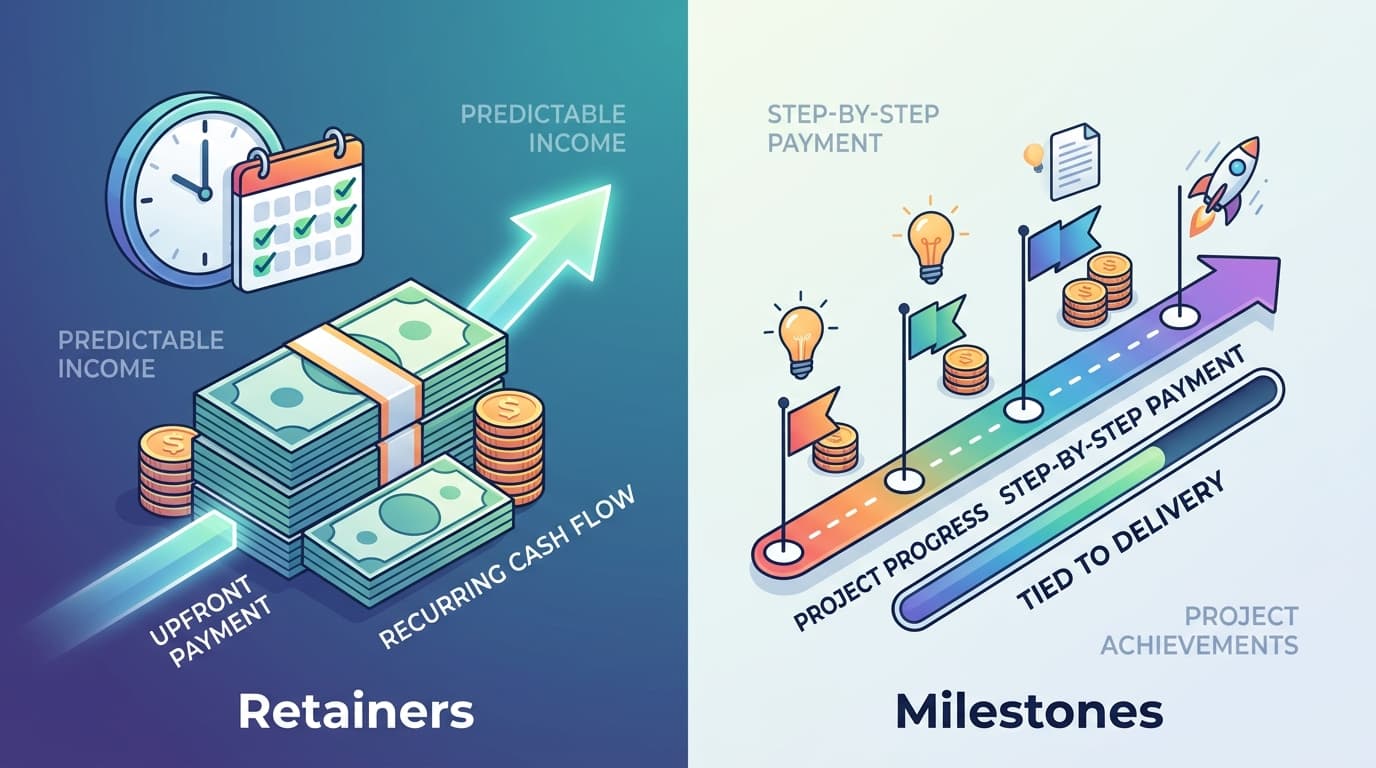
With a retainer, the client pays upfront for ongoing access, a defined capacity, or recurring deliverables over a set period. That means payment is tied to time reserved or scope committed, not just what gets shipped this week.
With milestone billing, the client pays at specific checkpoints: kickoff, first draft, revision round, launch, handoff, or another agreed stage. Payment is tied to progress events.
Why this matters: freelancers do not usually struggle because a client refuses to pay entirely. They struggle because the structure gives the client too many chances to delay, debate, or deprioritize payment.
Here is the practical difference:
- Retainers reduce decision points
- Milestones increase review points
- Fewer review points usually means fewer payment delays
If a client pays on the first of every month, there is not much to argue about. If a client pays after “approval of draft two,” now you have room for subjectivity, internal delays, and procurement excuses.
That does not make milestones bad. It means milestones need tighter definition.
For example:
Weak milestone term:
“50% due after strategy is complete.”
That invites questions like:
- What counts as complete?
- Does the client need to approve it?
- What if they take 12 days to review?
- What if they ask for one more workshop?
Strong milestone term:
“40% due at kickoff, 30% due upon delivery of homepage wireframes, 30% due before final source files and implementation handoff.”
That version is better because each event is observable. Less ambiguity means less delay.
The core lesson is simple: the payment model shapes client behavior. Clients move faster when money is attached to clear, automatic moments instead of vague progress language.
Retainers: Why They Often Win on Payment Speed
If your main goal is to get paid on time, retainers usually win.
That is because a retainer moves the payment conversation before the work starts, not after value has already been delivered.
Why retainers are easier to collect
Retainers work because they flip the usual freelancer dynamic.
Instead of saying, “I finished work, now please pay me,” you are saying, “Payment secures my availability and starts the engagement.”
That small shift changes everything.
Benefits of retainers for payment timing:
- Upfront cash flow
- Predictable monthly revenue
- Less invoice chasing
- Fewer approval-based disputes
- Clear client expectations around access and capacity
Why this matters: when you rely on post-delivery invoices, you are always one client delay away from a bad month.
A retainer also gives you leverage. If the next month’s payment has not come in, work pauses. That is much easier to enforce than trying to claw back a late payment for work already delivered.
Best-fit projects for retainers
Retainers are strongest when the work is ongoing and the client needs regular support.
Examples:
- Monthly design support
- Fractional marketing leadership
- SEO content production
- Website maintenance
- Paid ads management
- Productized consulting hours
If the client’s need continues, a retainer keeps billing simple.
For example, a freelance copywriter might structure an offer like this:
$3,000/month retainer includes:
- 4 blog posts
- 2 email campaigns
- 1 strategy call
- Up to 2 rounds of revisions per asset
- Delivery on a rolling monthly calendar
That is clean. The client knows what they get. The freelancer knows what is owed and when.
Where retainers go wrong
Retainers fail when freelancers sell them too loosely.
Common mistakes:
- No cap on revisions
- No response-time boundaries
- No definition of what is included
- No expiration on unused hours
- No payment due date tied to service start
This creates the worst possible setup: recurring payment with undefined scope.
If you offer retainers, your agreement should say:
- Payment is due before the service period begins
- Work begins only after payment is received
- Scope is defined by deliverables, hours, or access level
- Additional requests are billed separately
- Unused hours do not roll over unless explicitly stated
Why this matters: retainers are great for getting paid on time, but only if they are structured to prevent scope from expanding faster than revenue.
Milestones: Where They Work and Where They Break
Milestone billing is popular because it feels fair to both sides.
Clients like it because they pay as progress happens. Freelancers like it because they do not have to wait until the very end of a project to collect everything.
In many cases, this is a solid middle ground.
When milestones make sense
Milestones are best for finite projects with clear phases.
Examples:
- Branding packages
- Website builds
- App design projects
- Launch copywriting
- Course production
- One-time strategy engagements
A web designer might use:
- 50% upfront
- 25% after approved designs
- 25% before launch
That works because the project has visible stages.
Why this matters: if your work has a beginning, middle, and end, milestone billing can protect cash flow without forcing the client into a monthly commitment they do not want.
Why milestones get delayed
Milestones break when payments depend on approval language instead of delivery language.
Here is where freelancers get trapped:
- “Payment due after feedback”
- “Payment due after sign-off”
- “Payment due when the client is happy”
- “Payment due after final review”
All of these give the client room to stall.
A better rule is this: tie payment to your action, not their mood.
For example:
Instead of: “Second payment due upon approval of page designs.”
Use: “Second payment due upon delivery of page designs. Feedback window: 5 business days. Work pauses if payment is not received.”
That does three useful things:
- It defines the trigger
- It limits review drift
- It gives you permission to stop work
The biggest milestone mistake freelancers make
The worst version of milestone billing is too many tiny checkpoints.
If you split a $4,000 project into six small invoices, you do not reduce risk. You multiply admin.
Every invoice becomes another chance for:
- delay
- confusion
- accounting backlog
- procurement review
- “Can we discuss this first?”
A better rule is 2 to 4 payment points max for most projects.
For example:
- Small project: 100% upfront or 50/50
- Mid-size project: 50/25/25
- Large project: 40/30/20/10
Why this matters: milestone billing can support timely payment, but only when the milestones are few, clear, and tied to delivery events you control.
How to Choose the Right Model for Your Work
The right answer depends less on preference and more on the shape of the work.
A simple way to decide:
Choose retainers when:
- The client needs ongoing support
- Scope repeats month to month
- You are reserving time or capacity
- Speed and availability are part of the value
- You want stable monthly income
Choose milestones when:
- The project has a fixed outcome
- Deliverables are clearly phased
- There is a natural endpoint
- The client is hesitant about recurring fees
- You need a clear payment path for a one-time engagement
Why this matters: forcing the wrong billing model onto the wrong type of work leads to friction fast.
Quick comparison
Retainers are better for:
- predictability
- upfront payment
- reduced chasing
- ongoing relationships
Milestones are better for:
- project-based work
- easier initial client buy-in
- finite scope
- larger one-time engagements
A practical decision filter
Ask these four questions before you price anything:
-
Is this ongoing or finite?
If ongoing, lean retainer. -
Can the work be divided into clear phases?
If yes, milestones may fit. -
Do I need payment before I reserve significant time?
If yes, retainer or a large upfront milestone is safer. -
What can the client delay?
If the answer is “approvals,” do not attach payment to approval.
This is the real operating principle: choose the model that gives the client the fewest opportunities to slow cash down.
How to Get Paid Faster No Matter Which Model You Use
The billing model matters, but execution matters more.
A bad retainer setup can still pay late. A strong milestone setup can still pay fast.
Here is how serious freelancers improve payment speed regardless of model.
1. Collect money before the next block of work starts
This is the cleanest rule you can implement.
- Next month does not start until the retainer is paid
- Next phase does not start until the milestone is paid
- Final files are not released until the last payment is paid
Why this matters: when work keeps moving without payment, you train the client that deadlines matter more than invoices.
2. Use simple payment language on calls
Do not bury billing terms in a dense proposal and hope the client reads them later.
Say it live:
Retainer example:
“This is a monthly retainer billed in advance on the first. That secures the production capacity and support window for the month.”
Milestone example:
“This project is split into three payments: kickoff, delivery of wireframes, and pre-handoff. Each phase starts once the related payment is in.”
Short. Direct. Easy to agree to.
Why this matters: the more clearly you explain payment while the client is engaged, the fewer surprises appear after the call.
3. Remove vague approval dependencies
Any phrase that sounds subjective will slow payment.
Replace:
- after approval
- after satisfaction
- after sign-off
- after review completion
With:
- upon delivery
- before next phase begins
- within 5 business days of submission
- before transfer of final assets
Why this matters: clients cannot delay what is objectively defined.
4. Keep invoices boring
A good invoice should not raise new questions.
Include:
- project or retainer name
- exact payment amount
- due date
- what stage it covers
- payment link
- late fee policy if you use one
Do not make the client dig for the next action.
5. Close payment terms during the call, not after
This is where many freelancers lose momentum.
If you finish a discovery call, then send a PDF, wait for feedback, revise scope, and follow up for signature, you create a proposal gap. That gap is where enthusiasm fades and payment gets delayed before the project even begins.
A better approach is to discuss scope, pricing, and terms live, make adjustments in real time, and get agreement before the call ends.
Why this matters: faster agreement usually means faster payment, because there is no dead time between “yes” and “here is how we start.”
This is exactly why tools like Manager List are useful for freelancers. Instead of treating the proposal as a separate step, you can turn the call into the closing moment: present services, adjust pricing live, and capture the signature before the client disappears into their inbox.
That does not just help you win more deals. It helps you start with cleaner payment terms, which is usually the first step to getting paid on time.
Conclusion
If your goal is simply getting paid faster and more consistently, retainers usually have the edge because they collect payment before work begins and reduce approval-based delays.
Milestones still work well for fixed-scope projects, but only when they are tied to clear delivery events instead of vague client sign-off.
The real decision is not which model sounds more professional. It is which one gives you better control over cash flow, scope, and momentum.
Your next step is simple: look at your current offers and rewrite the payment structure so the trigger is clear, the number of payment points is limited, and no new work starts before the previous payment clears.
Frequently Asked Questions
- Are retainers always better than milestone billing for freelancers?
- No. Retainers are usually better for ongoing work because they improve predictability and collect payment earlier. Milestone billing is often better for fixed-scope projects with clear phases.
- What is the safest milestone structure for a freelance project?
- For most projects, use 2 to 4 payment points max. A common structure is 50% upfront, 25% on mid-project delivery, and 25% before final handoff.
- How do I stop clients from delaying milestone payments?
- Tie payment to delivery, not approval. Use language like 'payment due upon delivery' and pause work if payment is not received by the agreed date.
- Can I use both retainers and milestones?
- Yes. Many freelancers use milestone billing for the initial project, then move the client onto a retainer for ongoing support after launch.