
The 20 Minutes That Make or Break Your Freelance Deals
Most freelancers lose deals not because their work is bad, but because momentum dies between the call and the proposal. Learn how to close while the conversation is still hot.
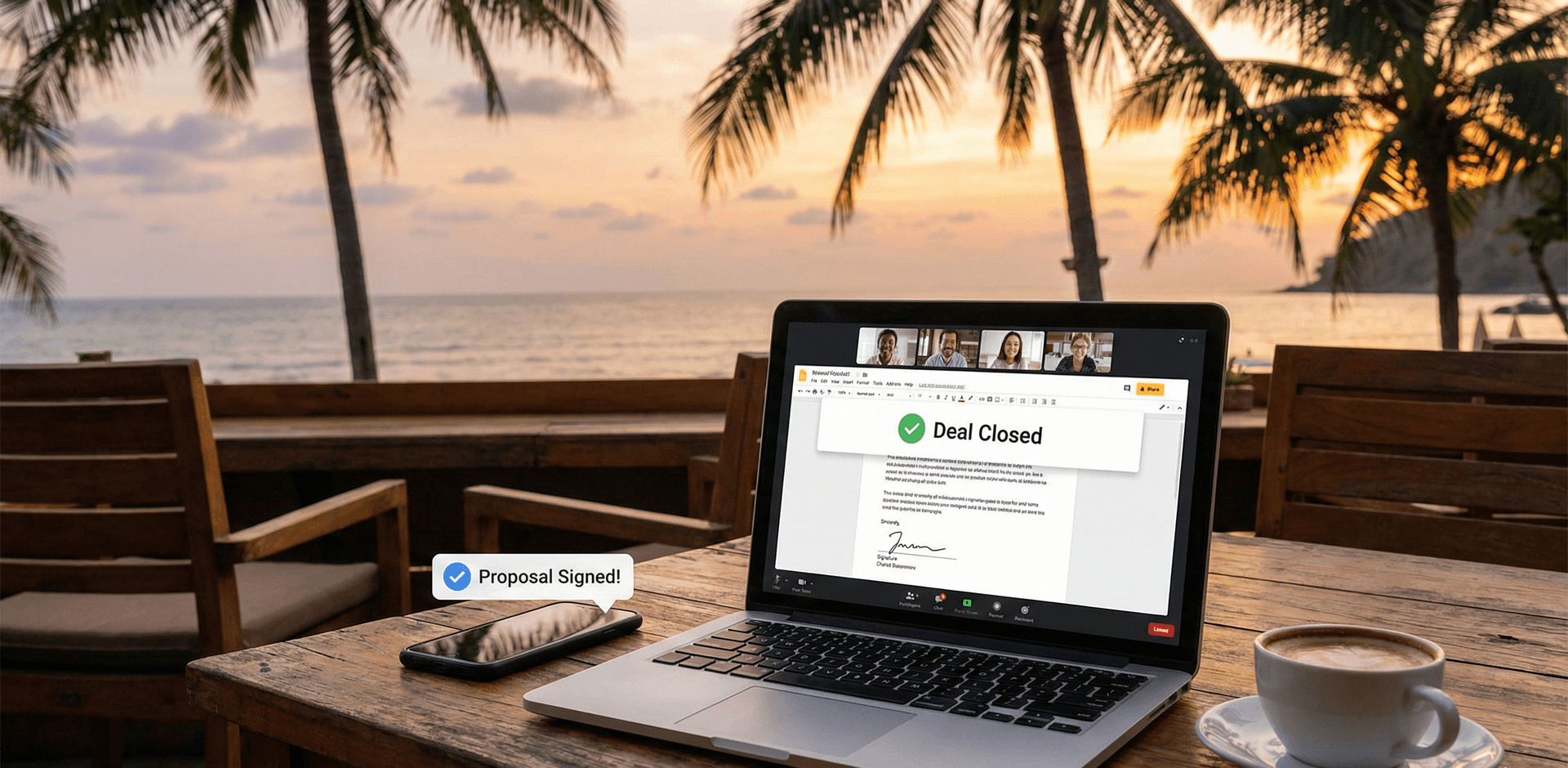
The Moment Everything Changes
There's a specific moment in every freelance deal where everything hangs in the balance.
It's not when the lead first reaches out. It's not when you send the proposal. It's not even when they sign.
It's the 20 minutes between "this sounds promising" and "let me think about it."
That window is where deals are won or lost. And if you're like most freelancers, you're unknowingly giving it away.
The Real Reason You're Losing Deals
Let's be honest about something.
You're not losing deals because your proposals are ugly. You're not losing them because you're a slow typer, or because you don't have fancy templates.
You're losing deals because:
- Momentum dies. The energy from a great conversation dissipates the moment you hang up.
- Clarity evaporates. What felt obvious during the call becomes fuzzy 24 hours later—for both of you.
- Confidence wobbles. The client who was nodding enthusiastically now has time to second-guess everything.
- Decisions get deferred. "Let me think about it" becomes "Let me compare options" becomes radio silence.
This isn't about your skills. It's about the gap you're creating between the conversation and the commitment.
Every hour that passes after a discovery call, your close rate drops. Not because you did anything wrong—but because you handed control back to entropy.
Where the Magic Actually Happens
Think about your freelance pipeline for a moment:
- Lead arrives — referral, DM, cold outreach, intro
- Discovery call — you learn what they need
- Proposal sent — you document and price it
- Decision made — they say yes, no, or nothing
- Work begins — (hopefully)
Now ask yourself: where is the highest-leverage moment in this entire sequence?
It's not step 1. That's just awareness.
It's not step 3. By then, you're already chasing.
It's the transition between steps 2 and 3—specifically, the last 20 minutes of the discovery call.
That moment is:
- Emotionally charged (they're excited, you're excited)
- Time-sensitive (attention is fleeting)
- Where most deals are actually decided
- Where freelancers feel the least confident
This is the moment that matters most. And most freelancers treat it as a throwaway—a transition to "the real work" of writing the proposal.
That's backwards.
The Traditional Approach (And Why It Fails)
Here's what most discovery calls look like:
During the call:
- You take messy notes
- You mentally promise scope you haven't priced
- You nod along to requirements you'll forget
- You end with "I'll send over a proposal"
After the call:
- You spend 1-3 hours reconstructing what was discussed
- You second-guess the pricing
- You polish a PDF nobody asked for
- You send it into the void and hope
What the client experiences:
- Radio silence for 24-72 hours
- A document that doesn't quite match what they remember
- Time to shop around, ask friends, or simply forget
- No momentum, no urgency, no reason to decide now
This is the proposal gap. And it's where deals go to die.
The gap isn't just about time—it's about psychology. During the call, you're collaborating. After the call, you're pitching. During the call, decisions feel natural. After the call, decisions feel like pressure.
You're literally working against human nature.
What Closing Live Actually Looks Like
Now imagine a different version of the same call:
Discovery unfolds normally. You ask questions, they explain their needs, you build rapport. Nothing changes here.
Then, around the 20-minute mark, you say:
"Let me show you how I usually structure this."
You share your screen. They see a clean interface with your services listed. As you talk through options, you toggle items on and off. The total updates in real-time.
"Based on what you've described, I'd recommend starting with these three components. The strategy piece is essential—that's where we'll define success metrics. The implementation can be phased if budget is a concern. And this optional add-on makes sense if you want to move faster."
They're watching. They're nodding. They're participating.
"Does this feel right? Anything you'd adjust?"
Maybe they ask about timeline. You add a note. Maybe they want to skip something. You toggle it off. The total updates. They see exactly what they're getting.
"If this looks good, you can sign right here and we'll get started this week."
Same link. Same screen. One click.
Deal closed.
No PDFs. No email chains. No "I'll think about it." No ghosting.
The conversation became the commitment.
The Psychology of Momentum
There's a reason this works, and it's not magic—it's psychology.
Decisions are easier in context
When someone is actively thinking about a problem, they're primed to solve it. The moment you hang up, that mental context starts to decay. Every hour that passes, they're further from the mindset where saying "yes" feels natural.
Collaboration beats presentation
During a live conversation, decisions feel collaborative. You're solving a problem together. A proposal sent later feels like a pitch—something to be evaluated, compared, and potentially rejected.
Specificity creates confidence
Abstract discussions ("we'll figure out the details later") create anxiety. Concrete scope ("here's exactly what you get for this price") creates confidence. When clients can see what they're buying, deciding becomes easier.
Urgency is natural, not manufactured
You don't need fake scarcity or pressure tactics. The natural urgency of a live conversation—the fact that you're both here, right now, focused on this—is enough. You're just not wasting it.
The enemy is delay, not rejection
Most freelancers fear hearing "no." But "no" is rarely your enemy. Your real enemy is "let me think about it"—because thinking almost always leads to inaction. By closing live, you're not being pushy. You're being helpful. You're saving them from decision fatigue.
The Power Shift
Here's what most freelancers don't realize:
The traditional proposal process puts you in a reactive position. You're waiting. Hoping. Following up without seeming desperate. The client holds all the power because they control the timeline.
Live closing flips this entirely.
When you close on the call:
- You lead instead of react. You're guiding the conversation toward a natural conclusion.
- You replace ambiguity with structure. Instead of vague discussions, you're showing concrete options.
- You preserve momentum. The energy from the conversation carries directly into the commitment.
- You demonstrate confidence. Nothing says "I know what I'm doing" like being prepared to close on the spot.
This isn't about being aggressive. It's about being prepared. It's about respecting your own time and theirs by not dragging out something that could be resolved now.
Clients actually prefer this. They came to you because they have a problem. They want it solved. Extending the decision process doesn't help them—it just creates more work for everyone.
What Manager List Actually Is
Let's be clear about what Manager List is not:
- ❌ It's not a proposal tool (those come after the call)
- ❌ It's not a CRM (that's about tracking, not closing)
- ❌ It's not a contract platform (that's about legal, not conversation)
- ❌ It's not a document builder (that's about formatting, not momentum)
Manager List is a live deal-closing interface for freelancers.
Or, more emotionally: the thing that turns conversations into commitments.
Here's how it works:
Before the call
You build your Library—a catalog of your services with descriptions and pricing. You can organize these into Packages and create Presets for common project types. This takes an hour to set up and saves hundreds of hours over time.
Starting the call
When a lead becomes real, you create a Client Space with one click. This generates a Live Link—a permanent URL that will serve this entire client relationship.
During the call
You share your screen and walk through the Live Link. As you discuss scope, you toggle services on and off. Add custom line items for unique requests. Adjust pricing if needed. The client watches the total update in real-time.
Closing the call
When everything looks right, the same link becomes a signing portal. The client enters their name, confirms, and the deal is done. No exports. No emails. No waiting.
After the call
That same link becomes the permanent record of your agreement. If scope changes later, you create an amendment—the client sees exactly what's new, what's removed, and signs to confirm. One link, forever.
The Same Link, Forever
This is one of the most underrated aspects of closing live: the link you share during the discovery call is the same link your client uses for the entire engagement.
During the call: It's your interactive pricing tool.
At closing: It's your signing portal.
During the project: It's your scope of record.
When questions arise: It's your reference point ("let's check what we agreed to").
When scope changes: It's your amendment tracker.
No more hunting through email chains. No more "which version did they sign?" No more scope creep arguments. One link, always current, always accessible.
This is what "source of truth" actually means in practice.
Closing Thoughts
The freelance world is full of advice about finding leads, building portfolios, and improving your craft. But almost nobody talks about the 20 minutes that actually determine whether you get paid.
You can have the best portfolio in the world, the most impressive testimonials, the perfect niche positioning—and still lose deals because you let momentum die.
The fix isn't working harder. It's not writing better proposals. It's not following up more persistently.
The fix is closing while the conversation is still alive.
Manager List exists to make that possible. Not by replacing your skills or automating your personality, but by giving you a tool that matches the speed of real conversations.
Because the best time to close a deal is while you're still on the call.
And the best proposal is the one your client helps you build.
Ready to stop losing deals to the proposal gap? Get started with Manager List for free and close your next deal on the call.