
Top 10 Issues Freelancers Face When Closing Deals (And How to Fix Them)
From scope creep to slow follow-ups, discover the biggest challenges freelancers face when closing deals and practical strategies to overcome them.
Introduction
Closing deals is the lifeblood of any freelance business, or any business for that matter. You can be the most talented designer, developer, or consultant in the world—but if you can't convert conversations into signed contracts, your skills don't pay the bills.
The truth is, most freelancers lose deals not because of their work quality, but because of what happens between the initial conversation and the signed agreement. It's in this gap where opportunities slip away, scope balloons out of control, and promising leads go cold.
After years of working with freelancers and experiencing these challenges firsthand, I've identified the ten most common issues that kill deals—and more importantly, how to fix them.
Issue 1: Slow Proposal Turnaround
The Problem: You have a great discovery call. The client is excited, you're excited, everything clicks. Then you tell them you'll send a proposal "by end of week." By the time you finally send it, their enthusiasm has cooled, they've talked to three other freelancers, and your proposal lands with a thud.
Why It Happens: Most freelancers don't have a system for quickly converting conversations into proposals. They're starting from scratch each time, manually formatting documents, and trying to remember what was discussed.
The Fix: Build reusable proposal templates with your standard services, pricing, and terms already in place. After each call, you should be able to customize and send within hours, not days. The freelancer who responds first often wins—not because they're better, but because they're faster.
Issue 2: Scope Creep Before the Contract
The Problem: During the sales process, the client keeps adding "just one more thing" to the project. By the time you're ready to send the proposal, the scope has ballooned far beyond the original conversation—but the client's budget expectations haven't moved.
Why It Happens: Freelancers want to be accommodating. Saying "yes" feels like good customer service. But without clear boundaries during the sales conversation, every "yes" sets unrealistic expectations.
The Fix: Practice phrases like "That's definitely possible—let me include that as an optional add-on in the proposal so you can see the investment." This acknowledges the request, maintains flexibility, and ties additional scope to additional cost before expectations solidify.
Issue 3: Unclear Deliverables
The Problem: You agree to "build a website" or "design a logo" but never define what that actually means. The client expects unlimited revisions and a dozen pages. You expected a simple five-page site with two revision rounds.
Why It Happens: Freelancers focus on the work itself and forget that clients don't think in terms of hours or complexity. They think in terms of outcomes—and their mental picture of the outcome may be wildly different from yours.
The Fix: Get specific during discovery. Instead of "I'll design your logo," say "I'll provide three initial concepts, you'll choose one, and we'll refine it through two rounds of revisions. The final deliverable includes vector files in AI, EPS, and SVG formats, plus a PNG for web use."
Issue 4: Pricing Paralysis
The Problem: You don't know what to charge. You've heard you should "charge what you're worth" but have no idea what that means. So you either lowball to win the job (and resent it later) or price so high you never hear back.
Why It Happens: Pricing is psychological. Without market data and confidence in your positioning, every price feels like a guess.
The Fix: Research what others charge for similar work. Create pricing tiers (Good/Better/Best) so clients have options. And remember: the client hired you because they can't do this work themselves. Your expertise has value—price accordingly.
Issue 5: Lost Meeting Notes
The Problem: You had a great call. The client mentioned their timeline, budget range, specific preferences, and key stakeholders. A week later, you're writing the proposal and... where did you write that down? Was it in a notebook? A Google Doc? Your phone?
Why It Happens: Freelancers bounce between tools and contexts. There's no single source of truth for client conversations.
The Fix: Use a dedicated system for capturing and organizing client call notes. Immediately after every call, transfer key details into a structured format: project scope, timeline, budget, decision-makers, and next steps. Future you will thank present you.
Issue 6: Unprofessional Presentation
The Problem: Your proposal is a Word document with inconsistent fonts, no branding, and a wall of text. It gets the information across, but it doesn't inspire confidence or stand out from competitors.
Why It Happens: Freelancers focus on the work, not the sales materials. Proposal design feels like a secondary concern.
The Fix: First impressions matter. Your proposal is a preview of the quality clients can expect from your work. Invest in a professional template with your branding, clear sections, and visual hierarchy. Make it easy to read and impossible to ignore.
Issue 7: No Follow-Up System
The Problem: You send the proposal and... wait. Days pass. A week passes. You're not sure if they received it, if they're reviewing it, or if they've moved on. Eventually, you send a sheepish "just following up" email that feels desperate.
Why It Happens: Following up feels awkward. Without a system, it's easy to let proposals disappear into the void.
The Fix: Set specific follow-up milestones before you send the proposal. Day 2: brief check-in. Day 5: add value (share a relevant article or insight). Day 10: direct ask for decision timeline. Confidence in your follow-up comes from having a plan.
Issue 8: Scope Ambiguity in Proposals
The Problem: Your proposal lists deliverables but doesn't clearly define boundaries. "Website development" could mean anything. When the client asks for additional pages or features post-signature, you have no contractual ground to stand on.
Why It Happens: Freelancers want to seem flexible and accommodating. Detailed boundaries feel restrictive.
The Fix: Be explicit about what's included and what's not included. "This proposal covers a 5-page website. Additional pages are available at $X each." Clear boundaries protect both parties and prevent the uncomfortable mid-project scope negotiation.
Issue 9: Lack of Social Proof
The Problem: The client is interested, but they've never worked with you before. They're taking a risk. Your proposal doesn't include any evidence that you've successfully completed similar projects.
Why It Happens: Gathering testimonials and case studies feels like extra work. Freelancers often skip this step.
The Fix: Build a library of brief testimonials and project summaries. Include 1-2 relevant examples in every proposal. "Here's a similar project I completed for [Client], which resulted in [specific outcome]." Social proof reduces perceived risk.
Issue 10: Revision Chaos
The Problem: The proposal goes back and forth. The client wants changes to scope, you update the document, they want more changes, versions multiply, and nobody knows which is current. The deal dies from confusion and friction.
Why It Happens: Email-based revisions create chaos. Multiple versions, unclear change tracking, and no single source of truth.
The Fix: Use a system that tracks proposal versions and makes revisions clean. Better yet, use a tool that allows clients to view and accept proposals online, eliminating the back-and-forth document tennis entirely.
Conclusion
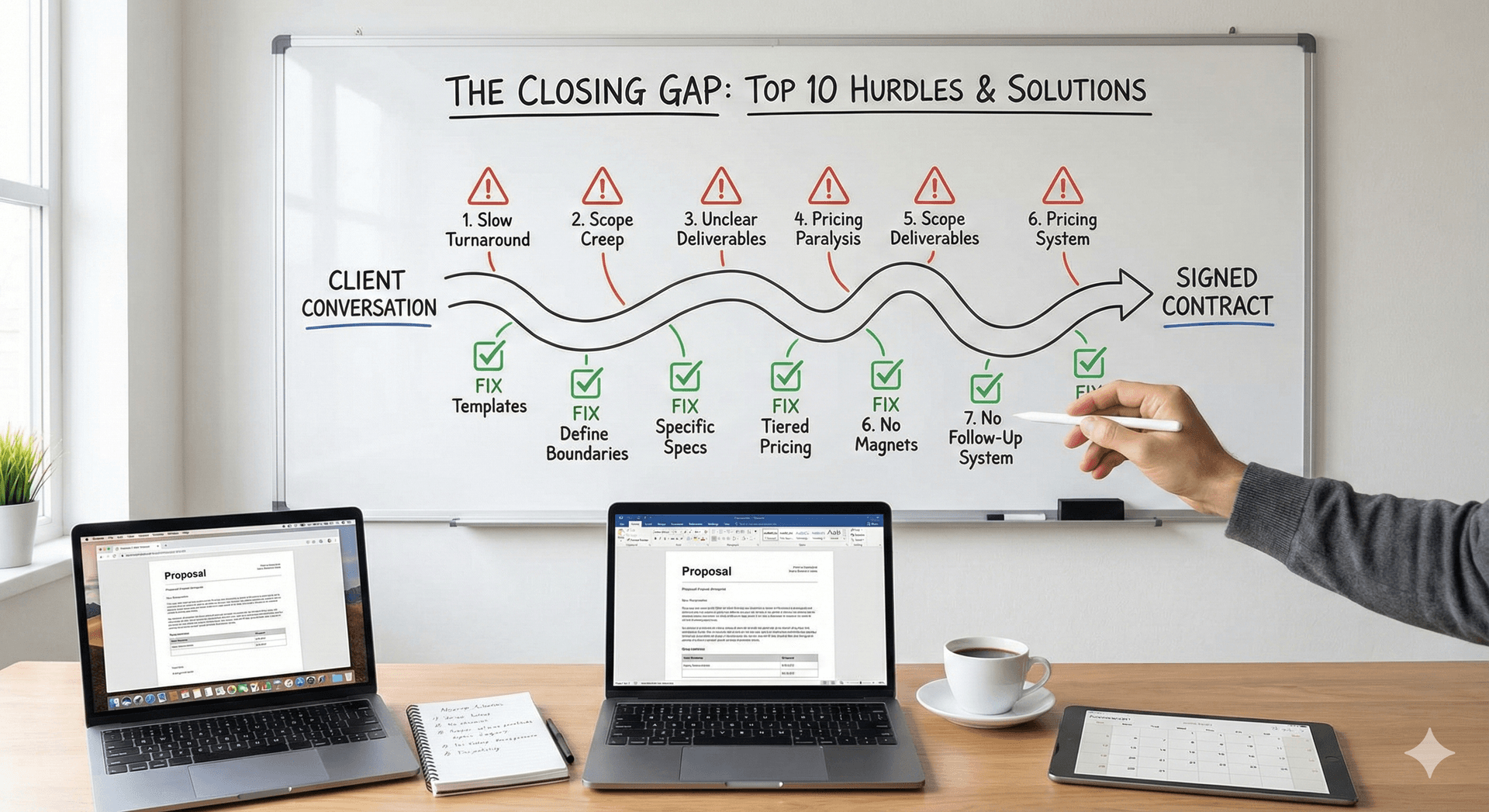
These ten issues share a common thread: they all happen in the gap between conversation and signed contract. It's in this critical window where deals are won or lost—not because of your skills or pricing, but because of your process.
The freelancers who consistently close deals aren't necessarily more talented. They're more systematic. They respond faster, document clearly, present professionally, and follow up confidently.
Every issue on this list is solvable with the right systems and habits. Start with the one that resonates most, fix it, then move to the next. Over time, you'll transform from a freelancer who occasionally closes deals into one who reliably converts conversations into contracts.
Your expertise deserves to get signed. Build the systems that make it happen.
Frequently Asked Questions
- How quickly should I send a proposal after a client call?
- Ideally within 24-48 hours. The faster you respond, the more likely the client is to still be engaged and enthusiastic. Waiting a week or more dramatically reduces your close rate.
- How do I prevent scope creep during the sales process?
- Acknowledge every additional request but tie it to additional cost. Use phrases like "That's possible—I'll include it as an optional add-on in the proposal so you can see the investment." This sets expectations before the contract is signed.
- What should I include in my proposal to prevent scope ambiguity?
- Explicitly list what's included AND what's not included. Define deliverables, revision rounds, timeline, and boundaries. Clear scope definitions protect both you and the client from mid-project misunderstandings.
- How many times should I follow up on a proposal?
- Plan for 3-4 follow-ups over 2-3 weeks. Space them out: a quick check-in at day 2, a value-add touch at day 5, a direct ask at day 10, and a final "closing the loop" message if needed. Persistence shows professionalism, not desperation.