
The Technology Behind Manager List: A Deep Dive
Explore the modern web technologies powering Manager List—from Next.js and React 19 to Supabase, Stripe, and edge deployment on Vercel.
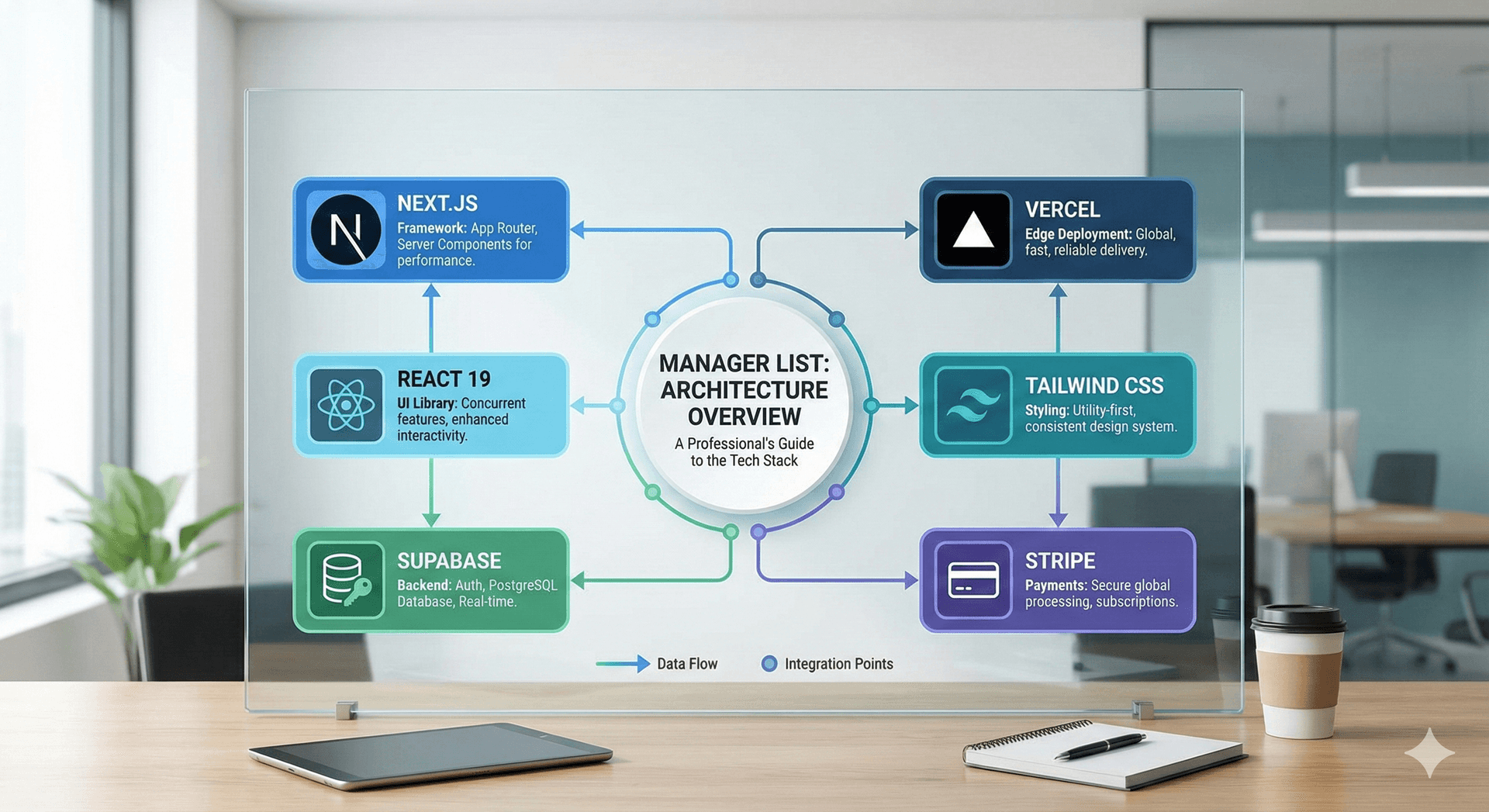
Introduction
Building a modern SaaS platform requires making hundreds of technology decisions—each one impacting performance, developer experience, scalability, and ultimately, how well the product serves its users. When I set out to build Manager List, I approached these decisions with a clear philosophy: choose technologies that prioritize speed, reliability, and long-term maintainability.
In this post, I'll take you behind the scenes of Manager List's technical architecture. Whether you're a developer curious about modern web stacks, a freelancer interested in what powers the tools you use, or an entrepreneur evaluating technology choices for your own project, this deep dive will give you insight into the reasoning behind every major technical decision.
The Core Philosophy
Before diving into specific technologies, it's worth understanding the principles that guided every decision:
Speed Over Everything
Freelancers are busy. When you're on a call with a client and need to generate a proposal, every second counts. The technical architecture was designed to minimize latency at every layer—from initial page load to real-time database updates.
Reliability as a Feature
Tools that freelancers depend on for their livelihood cannot afford downtime. We chose battle-tested technologies with strong track records over bleeding-edge experiments that might introduce instability.
Developer Experience Matters
A codebase that's easy to work with means faster iteration, fewer bugs, and quicker feature development. Technologies were evaluated not just on their end-user benefits, but on how pleasant they are to develop with.
Next.js: The Foundation
The entire Manager List platform is built on Next.js, the React framework that has become the gold standard for production web applications. We're using the latest version with the App Router architecture.
Why Next.js?
Next.js provides the perfect balance between developer experience and production performance. The framework handles complex concerns like:
- Routing — File-based routing that maps directly to URL structure
- Rendering — Flexible options for static, server, and client rendering
- Optimization — Automatic code splitting, image optimization, and font loading
- API Routes — Backend functionality alongside frontend code
The App Router Advantage
The newer App Router (introduced in Next.js 13 and matured in subsequent versions) brings significant improvements over the Pages Router:
- Layouts — Shared UI that persists across navigations without re-rendering
- Server Components — React components that render on the server by default
- Streaming — Progressive loading of UI as data becomes available
- Parallel Routes — Multiple pages that can be shown simultaneously
For freelancer tools that need to feel instant, these architectural patterns make a measurable difference in perceived performance.
For those wanting to dive deeper into Next.js development, I highly recommend this resource from JavaScript Mastery:
While this tutorial covers Next.js 15, the foundational concepts remain directly applicable to the latest version. It's an excellent resource for understanding the App Router paradigm and modern React patterns.
React 19 and Server Components
Manager List leverages React 19's latest features, including the revolutionary Server Components architecture.
What Are Server Components?
Traditional React applications send JavaScript to the browser, which then renders the UI. Server Components flip this model—components render on the server and send HTML to the browser. The benefits are substantial:
- Smaller Bundle Size — Server-only code never ships to the client
- Direct Database Access — Components can query databases without API layers
- Better SEO — Search engines see fully rendered HTML
- Improved Security — Sensitive logic stays on the server
Client Components When Needed
Not everything belongs on the server. Interactive elements like forms, dropdowns, and real-time updates require client-side JavaScript. React 19's architecture makes it easy to mix server and client components, using each where they make the most sense.
Concurrent Features
React 19 includes performance improvements that make UI feel more responsive:
- Automatic Batching — Multiple state updates combine into single re-renders
- Transitions — Non-urgent updates don't block user input
- Suspense — Graceful loading states while data fetches
Supabase: Authentication and Database
For authentication and data storage, Manager List uses Supabase—an open-source Firebase alternative built on PostgreSQL.
Why Supabase?
Supabase provides the complete backend infrastructure freelancer tools need:
- PostgreSQL Database — A proven, powerful relational database
- Authentication — Email, OAuth, and magic link login out of the box
- Row Level Security — Database-level access control for multi-tenant apps
- Real-time Subscriptions — Live updates when data changes
- Edge Functions — Serverless functions for custom backend logic
The PostgreSQL Advantage
Unlike NoSQL alternatives, PostgreSQL's relational model handles the structured data of proposals, clients, and services exceptionally well. Complex queries, joins, and transactions work reliably—critical for financial and business data.
Real-time for Collaboration
When a client views a proposal or makes a comment, Supabase's real-time subscriptions can push updates instantly. This foundation enables collaborative features planned for future versions.
Stripe: Payment Processing
Payment processing is handled by Stripe, the industry standard for online payments.
Why Stripe?
For a platform serving freelancers, payment reliability is non-negotiable. Stripe provides:
- Global Coverage — Supports 135+ currencies and payment methods worldwide
- Subscription Management — Built-in handling for recurring billing
- Fraud Prevention — Machine learning that protects against fraudulent payments
- Developer Experience — Excellent APIs and documentation
- Compliance — PCI DSS compliance handled automatically
Integration Patterns
Manager List uses Stripe's modern integration patterns:
- Stripe Elements — Pre-built, customizable payment UI components
- Webhooks — Reliable event notifications for payment status changes
- Customer Portal — Self-service subscription management for users
Tailwind CSS: Styling at Scale
The entire Manager List interface is styled with Tailwind CSS, a utility-first CSS framework.
Why Tailwind?
Tailwind's utility-first approach offers significant advantages for rapid development:
- No Context Switching — Styles live alongside markup, eliminating CSS file juggling
- Consistent Design — Predefined scales for spacing, colors, and typography
- Small Production Bundle — Unused styles are automatically purged
- Responsive Design — Mobile-first breakpoints built into the class naming
Design System Integration
Tailwind's configuration allows defining custom design tokens—colors, fonts, and spacing—that maintain visual consistency across the entire application. Manager List's dark theme, accent colors, and typography scale are all defined in one central configuration.
Vercel: Edge Deployment
Manager List is deployed on Vercel, the platform created by the team behind Next.js.
Why Vercel?
Vercel provides edge-first deployment that makes applications fast globally:
- Edge Network — Content served from servers closest to each user
- Automatic Scaling — Handles traffic spikes without manual intervention
- Preview Deployments — Every git branch gets its own URL for testing
- Analytics — Real-time performance and usage metrics
- Integration — Native support for Next.js features
Edge Functions
Vercel's Edge Functions run code at the network edge, reducing latency for dynamic content. For freelancer tools where every millisecond matters, this architecture ensures fast response times regardless of user location.
Zero-Config Deployment
Pushing to the main branch triggers automatic deployments. No CI/CD configuration required—Vercel detects Next.js projects and applies optimal build settings automatically.
Why These Choices Matter for Freelancers
You might wonder why the technology stack matters if you're just using the tool to send proposals. Here's why these choices directly impact your experience:
Faster Page Loads
Server Components and edge deployment mean Manager List loads quickly, even on slower connections. When you're on a call and need to pull up a template, speed matters.
Reliable Uptime
Battle-tested technologies like PostgreSQL and Stripe mean fewer unexpected outages. Your proposals and payments work when you need them.
Data Security
Row Level Security, encrypted connections, and Stripe's PCI compliance ensure your business data and client information stay protected.
Continuous Improvement
A modern, maintainable codebase means new features can be developed and deployed quickly. The technical foundation supports rapid iteration based on user feedback.
Conclusion
The technology behind Manager List wasn't chosen to be trendy—each decision serves the core mission of helping freelancers close deals faster. From Next.js's performance optimizations to Supabase's real-time capabilities, every layer of the stack contributes to a tool that's fast, reliable, and genuinely useful.
For developers considering similar stacks, this combination offers an excellent balance of developer experience and production performance. For freelancers using Manager List, these technology choices translate into a tool that works the way you work—quickly, reliably, and without friction.
The stack will continue evolving as web technologies advance, but the core philosophy remains constant: build tools that respect freelancers' time and help them succeed.
Frequently Asked Questions
- Why does the technology stack matter for a proposal tool?
- The technology stack directly impacts performance, reliability, and security. Faster page loads mean less friction during client calls. Reliable infrastructure means your proposals are always accessible. Modern security practices protect your business and client data.
- Is Manager List open source?
- Manager List is a commercial product, but it is built on open-source technologies including Next.js, React, Supabase, and Tailwind CSS. We believe in leveraging the best open-source tools while providing a polished, hosted experience for freelancers.
- How does edge deployment improve performance?
- Edge deployment serves content from servers geographically close to each user. Instead of all requests going to a single data center, users connect to the nearest edge location. This reduces latency and makes the application feel faster regardless of where you are in the world.